


If you and your competitors all bring the same powerful AI tools to your innovation work — similar models, similar prompts, similar data — what kind of ideas will you all end up producing? And in a market where good ideas can now be generated faster and more cheaply than ever before, where will your real competitive advantage come from?
Today, let me share the argument I recently presented at the ISPIM (International Society of Professional Innovation Management) Innovation Conference in Granada, Spain, drawn from a conceptual paper titled Non-Conscious Creativity: A Human Advantage in the AI Age. The short version is this: as AI becomes increasingly capable at structured, conscious creativity, the source of human competitive advantage shifts toward something innovation management has largely neglected for the last seventy years — the non-conscious side of the creative mind. Let me make the case in three acts.
Act I — How We Manage Creativity Today
Start with how we currently run creativity inside innovation projects. Whether we use the classic or simplified Creative Problem Solving (CPS) Method, Design Thinking, our own X-IDEA, or any similar approach, they all share the same underlying logic. They alternate between divergent and convergent phases. They use creativity techniques and serious thinking tools. And almost everything happens through deliberate, conscious thinking.
You can see the same logic in the classic conscious thinking toolkit most innovation facilitators reach for. On the divergence side: brainstorming, SCAMPER, TRIZ, lateral thinking, among many other creativity techniques. On the convergence side: weighted scoring, stage-gates, portfolio management, and other serious thinking tools. The observation is simple. Everything is visible. Everything is deliberate. Everything is conscious. In conclusion, over the last seven decades, modern innovation management has become extremely good at structuring conscious creativity.
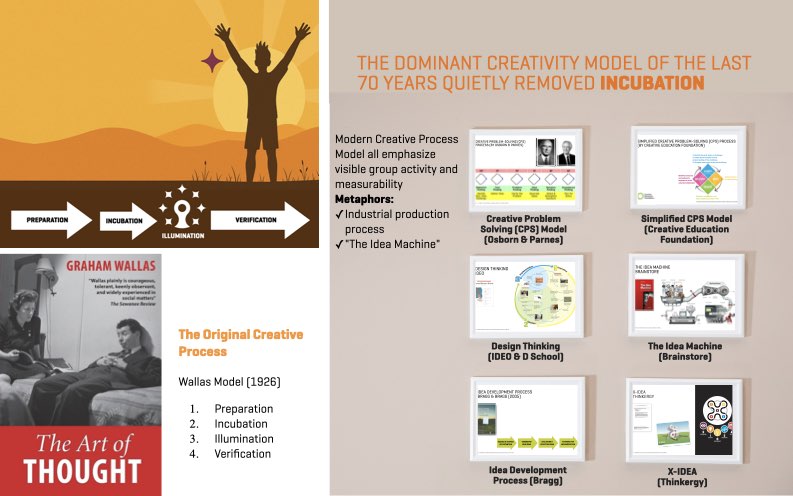
This worked well enough — until AI arrived. AI is faster. AI is cheaper. AI is scalable. And increasingly, it is very good at creative work. In a recent study with my colleague Dr. Ronald Vatananan-Thesenvitz, we found that AI performed at near parity with human teams even in the Development stage of X-IDEA — the demanding stage where raw ideas are transformed into high-quality concepts.
That creates a strategic problem. If everyone uses similar models, similar prompts, and similar datasets, we may gain better optimization — but we may also get more sameness, more incremental innovation, and fewer genuine breakthroughs. Meanwhile, a disruptive newcomer may still arrive with a radically different idea, produced through non-conscious creative mechanisms that our innovation systems largely ignore.
Act II — The Missing Half of Creativity
What if we have been looking at only half of the creativity system? Everything in Act I sits above the waterline: conscious, visible, managed. But breakthrough innovation often emerges from what happens below the surface.
[Suggested image: the iceberg — conscious creativity above the waterline, non-conscious creativity below.]
Albert Einstein once observed: "The intuitive mind is a sacred gift and the rational mind is a faithful servant. We have created a society that honors the servant and has forgotten the gift." For seventy years, we have built our innovation systems almost entirely around the servant.
The remarkable thing is that we understood the gift a hundred years ago. In 1926, Graham Wallas described the creative process in four stages in his classic book The Art of Thought: preparation, incubation, illumination, and verification. Yet most modern creative process methods quietly removed incubation — the one stage that cannot be rushed, scheduled, or performed on cue. Consider how breakthroughs have actually happened:
- Henri Poincaré's breakthrough — the sudden realization that the transformations behind his Fuchsian functions were identical to those of non-Euclidean geometry — came to him as he stepped onto an omnibus during a geological excursion, with nothing in his prior thinking seeming to have paved the way.
- Hermann von Helmholtz reported his best ideas coming on morning walks. August Kekulé glimpsed the ring structure of benzene in a half-sleep.
- Albert Einstein had his decisive insight into relativity while hiking in nature and talking to a friend.
Different people, different contexts, the same pattern — not intense conscious effort, but preparation, followed by incubation, followed by sudden illumination. As Henri Poincaré described such sudden illuminations, the idea arrives with "brevity, suddenness and immediate certainty."
(Every creative person has their own version of this. In a recent two-part series, 8 Ways to Invite a Breakthrough Idea (Part 1) | (Part 2), I described eight practices that deliberately invite these states. Here I am concerned with something larger — not the individual practice, but the system around it.)

This points to the distinction that matters most in the AI age. Incremental creativity extends existing solution spaces. Breakthrough creativity restructures them. One is largely conscious. The other is strongly linked to non-conscious processing. The full contrast is worth laying out side by side:
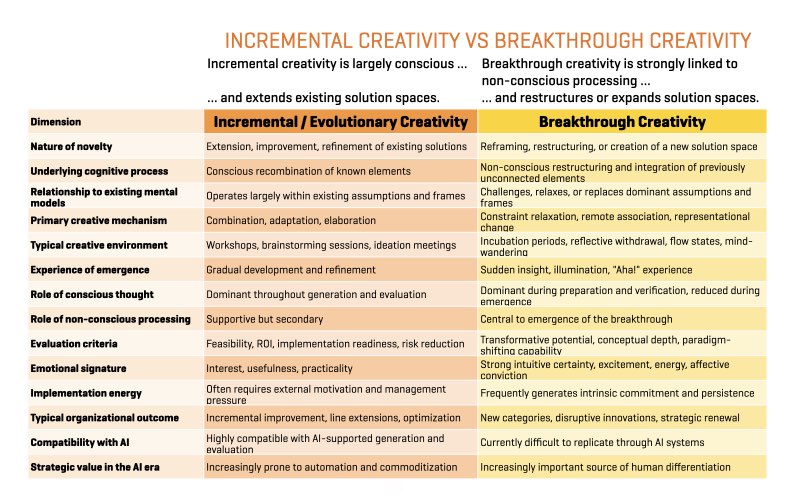
Read the bottom two rows together, and the whole argument comes into focus. The layer AI is mastering is precisely the layer that produces sameness. The layer it cannot reach is precisely the layer that produces breakthroughs.
Act III — A New Paradigm
So the future is not a contest of AI against humans. It is a partnership of AI with non-consciously creative humans. The proposal is straightforward.
Use AI and humans together for exploration, ideation, and development — the conscious, structured stages where machines genuinely help. Then deliberately introduce incubation. Create space for non-conscious processing. Allow breakthrough insights to emerge. Then return to evaluation and implementation. In X-IDEA terms, you let AI and humans work the X, I, D, E, and A stages — and you protect a quiet human interval between them, where the deeper mind can do what no algorithm can.
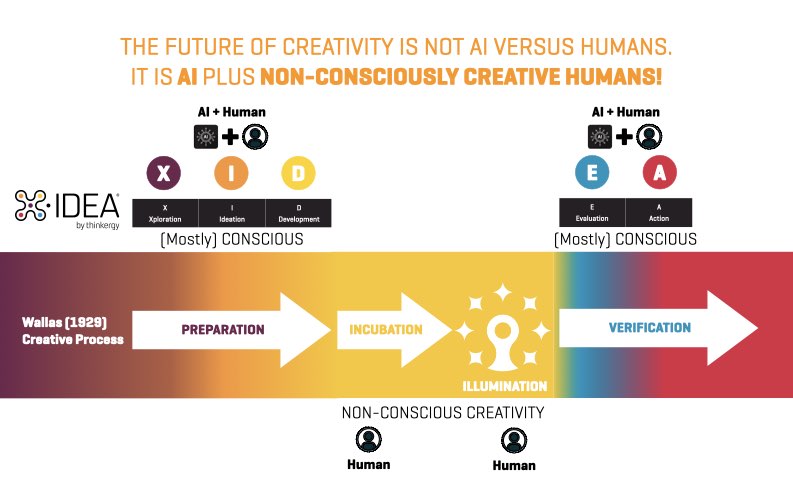
If organizations want more breakthroughs, they need to rebalance their innovation systems. In practice, that means a few deliberate moves:
- Legitimize incubation. Treat reflective disengagement as real work, not as time off from it. The breakthrough you need may depend on the pause you refuse to schedule.
Tip: Protect a recurring block of unstructured thinking time as carefully as you protect a project deadline. - Design rhythms that alternate intensity and recovery. Continuous activity keeps the conscious mind in charge and crowds out the states where restructuring happens. Build the oscillation in on purpose.
Tip: Pair every intense ideation sprint with a genuine recovery interval before the next decision is forced. - Reward depth, and role-model it yourself. Recognize insight that arrives outside the formal session, and evaluate conceptual depth alongside output quantity. Stop equating visible busyness with value. Start protecting the reflective time where breakthroughs are actually born. As Peter Drucker warned, "There is nothing so useless as doing efficiently that which should not be done at all."
Lesson: Non-conscious creativity stays culturally fragile until creative leaders make it safe — by living it, not just permitting it.
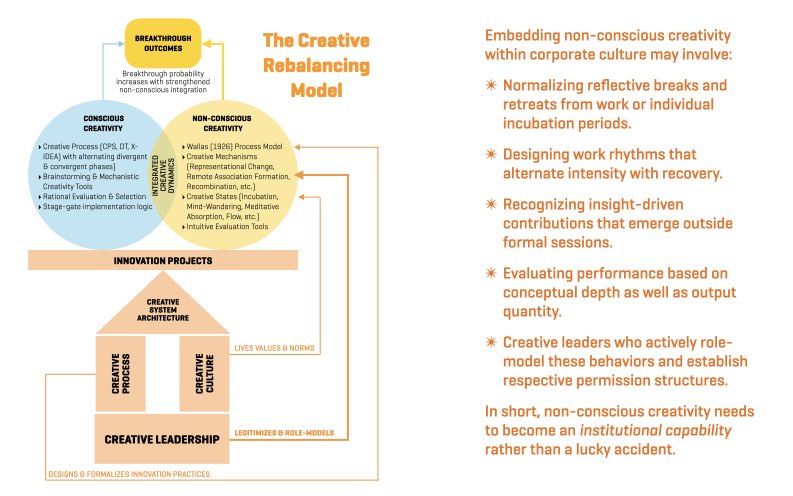
Taken together, these moves describe a shift in what an innovation system is for. Conscious and non-conscious creativity both feed breakthrough outcomes; a healthy creative architecture protects both; and creative leadership is the condition that makes the whole thing hold. In short, non-conscious creativity needs to become an institutional capability rather than a lucky accident.
None of this means using less AI. It means rebalancing — pairing the conscious, structured creativity that machines now perform so well with the non-conscious, restructuring creativity that only humans can reach. The organizations that win in the AI age may not be those that use the most AI, but those that become best at unlocking the creativity AI cannot access. Because the future is not AI versus humans. It is AI plus non-consciously creative humans.
© Dr. Detlef Reis 2026.
- This argument is developed at length in the research paper I presented at ISPIM Granada. Find it here.
- Want to build the creative leadership that legitimizes and role-models this rebalancing? Genius Journey is the creative leadership development method built for exactly this. To learn more about Genius Journey, visit the website, download the introductory booklet, or contact us to design an engagement.