


In Part 1 of this article two weeks ago, I described the iceberg of the creative mind — the conscious tip above the waterline, the vast subconscious below, and the superconscious sea the whole iceberg floats in. I shared the first four practices for accessing the deeper waters: lingering in the liminal, meditating, daydreaming on purpose, and taking a walk to let the mind wander. All four were receptive — you create the conditions, then you listen.
Today, let me share the other four. These are largely expressive — you don't sit quietly, you talk, you write, you imagine entire conversations with people who aren't in the room. And the final one is the master practice that pulls all the others together, and that has produced both of the biggest breakthroughs of my own life.
A Reminder Before We Begin
The same precondition from Part 1 still applies. None of these practices works in a vacuum. The subconscious activates only when you've given it something worth working on — a real challenge you've committed to and lived with for long enough that it has become part of you. Keep your challenge gently in mind as you read.
5. Take an Insight Walkie-Talkie
In 1905, a young patent clerk named Albert Einstein had been wrestling for years with a problem that would eventually become his special theory of relativity. One afternoon, he took a walk through the Swiss Alps near Bern with his close friend Michele Besso and began talking — explaining, complaining, thinking aloud about the puzzle that had been consuming him. Besso did nothing extraordinary. He just walked alongside and listened. Mid-sentence, the breakthrough struck. Einstein ran home. The next day, when he saw Besso again, his first words were: "Thank you. I have completely solved the problem."
That walk inspired me to formalize a technique I call the Insight Walkie-Talkie.
Here is how it works. You take a walk — forty-five to sixty minutes, ideally in nature — with a trusted friend or colleague. You do almost all of the talking. They do almost all of the listening. Your job is to explain the challenge you've been carrying — what it is, why it matters, what you've tried, where you're stuck. Their job is only to listen, occasionally asking a question to keep you going. No advice. No solutions. No interruptions to share their own opinion. Just presence, and a few well-placed questions.
What happens, almost without fail, is this: somewhere in the second half of the walk, you start hearing yourself say things you didn't know you knew. The combination of walking (mind-wandering) and talking (expressive externalization) pulls insights up from the deeper mind that would never have surfaced at your desk. Einstein got relativity this way. You can get your own breakthrough this way too.
I will explore this technique more fully in a future article. For now, try it once. Pick a friend you trust. Tell them you need them only to listen.
Tip: Record the walk if your friend agrees. The best lines come fast and are often forgotten by the time you sit back down.
6. Try Stream-of-Consciousness Writing
If you don't have a friend available, the next-best expressive practice is to do it on paper. Sit down — at your desk, in a quiet coffee shop, anywhere undisturbed. Open a blank page. Write your challenge at the top. And then write for at least twenty minutes without stopping, without editing, without judging what comes out.
The first ten minutes will produce surface-level content — the things you already knew you thought. The interesting work happens in the second half. Once your hand outruns your inner critic, the deeper mind starts feeding sentences up through your fingers that you didn't know you had. This is what writers mean when they say a piece "wrote itself.”
The English novelist E. M. Forster captured the mechanism in a single question: "How do I know what I think until I see what I say?" That is stream-of-consciousness writing in eight words.
The underlying creative state behind both the Walkie-Talkie and stream-of-consciousness writing is deep focus and creative immersion. You don't break the spell to ask whether what's coming out is good. You let it come. You judge later.
Tip: Write longhand if you can. The slower pace of the pen forces a different brain state than typing — and the friction is part of what surfaces the deeper material.

7. Convene Your Star Advisory Board
This practice goes back to Napoleon Hill's Think and Grow Rich, where he describes a technique he called the Invisible Counselors. It is one of the most powerful — and most unfamiliar — practices in the set.
Here is how it works. You choose six to eight luminaries — geniuses, leaders, thinkers, creators — whom you deeply admire and whose minds and work you know well. They can be living or dead. Then you set aside an hour, get into a state of deep relaxation, and imagine them seated around a table with you. You present your challenge. And then, one by one, you let each of them speak — not by guessing what they would say, but by stepping into their voice, opening your mouth, and letting their counsel emerge from your subconscious mind. It feels strange the first time. It works anyway.
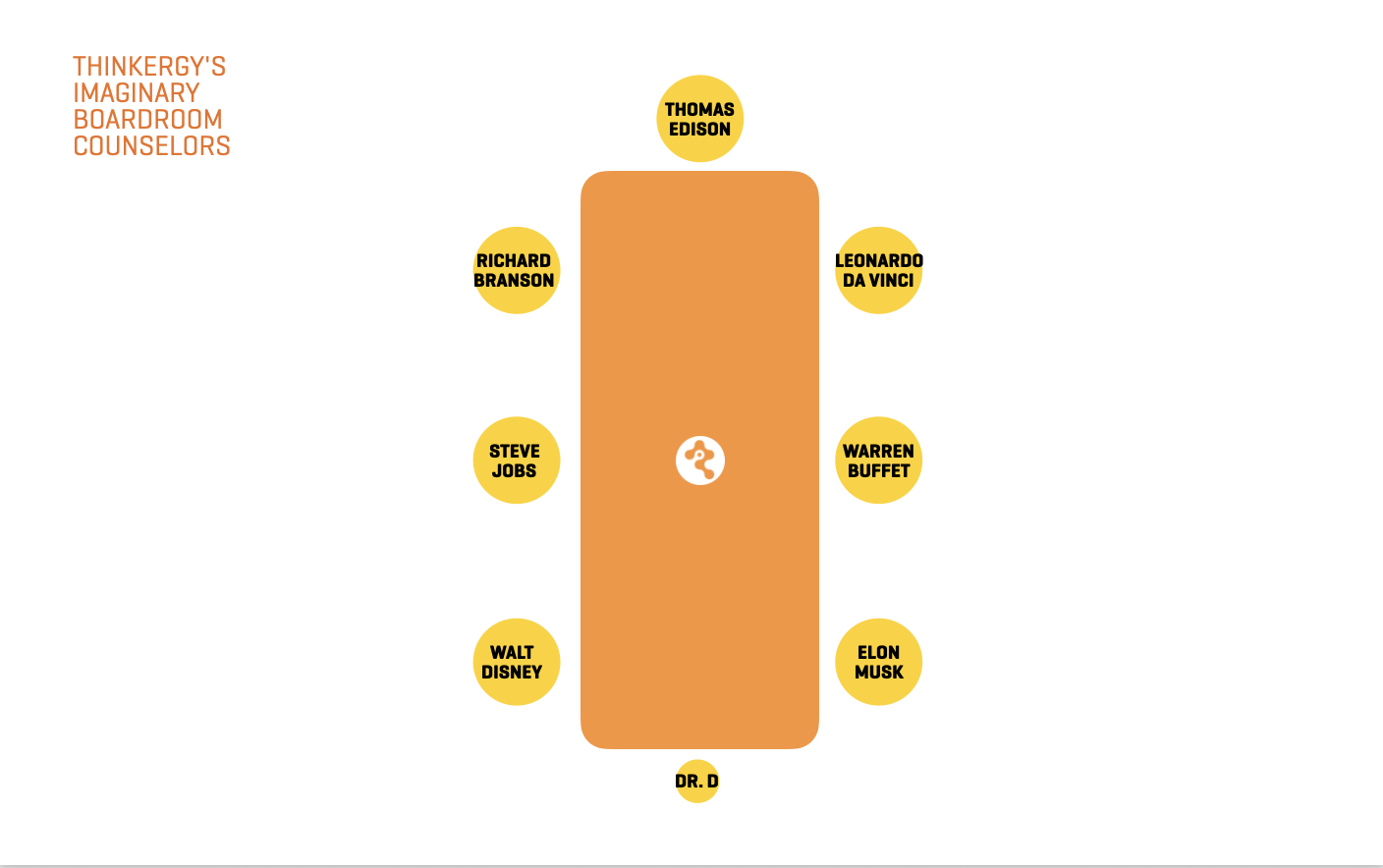
I keep a standing advisory board. One of my regulars is Walt Disney. In a recent session, with the topic of how to thrive as a creative leader in the AI age on the table, Walt gave me a piece of advice that has changed how I work: visualize everything. As more and more cognitive work gets delegated to AI, the differentiating human skill becomes the ability to see concepts — to sketch them, map them, draw them, render them in space. The conscious mind types. The subconscious mind draws. When asked for a final one-liner of advice, Walt gave me this variation of one of his classical quotes: “If you can sketch it, you can do it.”
I have made this part of my daily practice. Before I work on anything substantial, I now sketch or map it out — a concept map, a chart or timeline, a quick diagram on paper. This morning, before writing a single sentence of this article, I drew the whole structure: what subconscious and superconscious creativity are, why they matter, the role of the challenge, and all eight techniques laid out in a map. The map invited my subconscious to point at things I hadn't yet considered. Several of the sharpest lines in both parts of this article came from that fifteen-minute sketch, not from the writing itself.
Tip: Record the advisory board session on your phone. Process it the next day. What sounds like nonsense in the moment often turns out to be the most useful counsel once the conscious mind has had a chance to catch up.
8. Incubate
Incubation is the master practice. It is the second of four steps in the classic creative process model formulated a century ago by the British social psychologist Graham Wallas: preparation, incubation, illumination, and verification. You prepare your mind by working hard on a challenge. You incubate by letting go of it completely. You experience illumination when the breakthrough idea suddenly arrives. You verify it by testing whether it actually holds up.
The hard step is incubation. It demands two things most driven people resist. First, you must have prepared deeply — worked on a real challenge for weeks, months, sometimes years, until it has fully saturated your conscious mind. Second, you must then completely let go — stop chasing, stop forcing, stop even thinking about the problem — and trust that the deeper mind will keep working without your supervision.

Both of the largest breakthroughs of my life arrived through incubation:
- The first was the operationalization idea that saved my Ph.D. I had worked on the thesis for almost two years. I had a one-week deadline to crack the problem or be expelled. After a day and a half of grinding through more literature, I let go completely — running, calling friends, watching TV, browsing comics. On day four, the breakthrough arrived mid-run.
- The second was bigger. On Chinese New Year's Day in 2003, after four months of agonizing over what to do with the rest of my life, I had a Eureka moment in Bangkok that revealed who I really was and what I was here to do: start a creativity and innovation company. That company became Thinkergy. The realization didn't come from analysis. It came from incubation — from having worked the question hard enough, then letting go long enough for the deeper mind to deliver the answer.
When illumination arrives this way, it doesn't feel like your idea. It feels like an idea you received. This, in my experience, is what people mean when they speak of superconscious creativity. The idea comes from outside the boundary of the individual mind — from what Jung called the collective unconscious, from what spiritual traditions call the field. You did the preparation. The sea delivered the gift.
Tip: When you incubate, really incubate. Half-letting-go is just continued striving in disguise. The deeper mind knows the difference.
Eight Doorways, One Threshold
Eight practices. Four receptive, four expressive. Each one a different doorway into the same hidden territory — where your most original ideas have been waiting all along for you to stop chasing them and start inviting them.
But all eight doorways open onto a single threshold, and that threshold is your willingness to do two things at once: to commit fully to a challenge that matters, and to let go of needing to solve it on demand.
Prepare with everything you have. Then let go with everything you are. That is where breakthroughs are born.
© Dr. Detlef Reis 2026.
- Ready to bring these eight practices — and the deeper mindset work behind them — into your team or organization? Travel the Genius Journey with us as a day trip or a full workshop journey. Contact us to design the right engagement for you.
- Want to explore the method on your own first? Visit the Genius Journey website or download the introductory booklet.