


Eight years ago, I wrote in this blog that the pendulum of globalization had begun to swing back — and that the sixth long wave of innovation would start around 2020. Both of those things happened. What I did not see clearly at the time was how much the first would shape the second.
Today, let me invite you to zoom out. Way out. We are going to put one hundred and fifty years of history on a single page, and then come back to the decisions you are making this quarter.
The Wave You Are Already Riding
We have discussed the Sixth Wave here before. It began around 2020 and will run to roughly 2045, and it will be driven by the convergence of three technology spaces: digital technologies, which supply the intelligence; clean and sustainable technologies, which answer the constraint; and human-centered technologies, which supply the meaning. Digital is the engine that drives all three together. Wherever two of these spaces overlap, opportunity is being created faster than most organizations can absorb it.
Notice also what is happening to the clock itself. The Third Wave took roughly fifty years to unfold. The Sixth looks likely to run about twenty-five. Your window to catch this wave is half as wide as your grandfather's was.
So far, so exciting. But here is the thing almost nobody tells you: a technological wave never arrives into an empty room. It arrives into a world that has its own weather — and this wave is arriving into very different weather than the last one.
Two Clocks Nobody Watches
Two other forces unfold over decades, largely unnoticed, and both are turning right now.
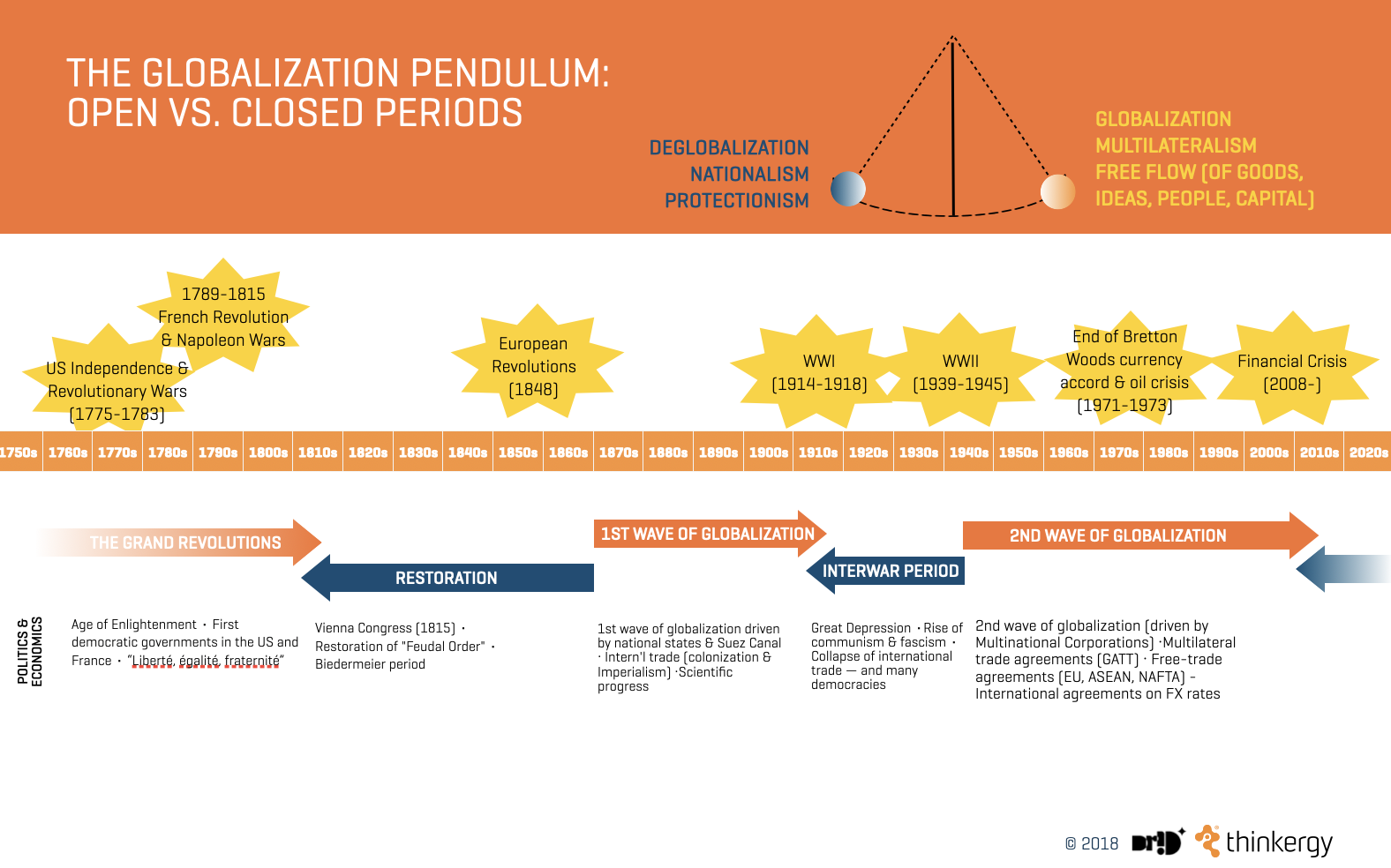
The first is the pendulum between globalization and deglobalization — the swing between an open world and a closed one, measured by how freely goods, capital, people, and ideas cross borders. I wrote about this in the aforementioned earlier blog article and devoted a section of my Unleashing WOW! book to it. The modern pattern begins around 1870, when the great European nation-states were founded, the Suez Canal opened, and the age of imperial expansion pulled the world into one trading system. That opening lasted until 1914. Then came a closure from 1918 to 1950 — protectionism, depression, two wars. Then a long opening from 1950 to 2008, the most integrated era in human history. And since roughly 2016, the pendulum has been swinging back again: trade wars, industrial policy, technological sovereignty, supply chains pulled home, blocs forming.
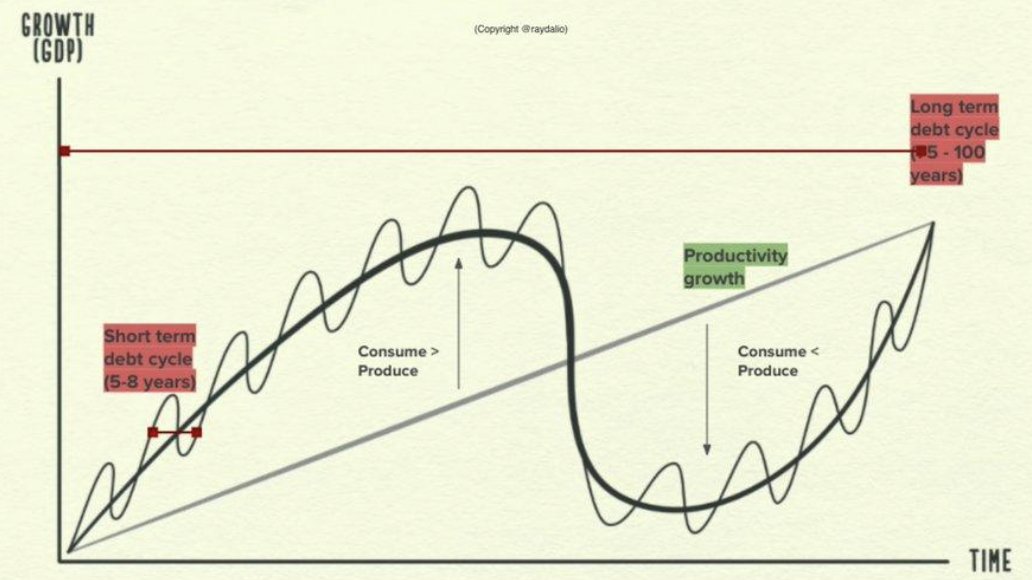
The second clock is the long-term debt cycle, mapped most clearly by Ray Dalio. Short debt cycles run five to eight years and everybody feels them. The long one runs seventy-five to one hundred years — and almost nobody sees it, because it comes around once in a lifetime. The current one began in 1945. We are in year eighty-one.
Follow the money regime across the same window and you get a sequence rather than a cycle: gold standard, war debt, Bretton Woods, credit expansion, quantitative easing — and now, debt overhang, with high indebtedness meeting rising interest rates.
Every Wave Has a Crash in the Middle
Before we put these together, one more piece of vocabulary. Carlota Perez showed that every technological revolution moves through four phases. First irruption, when the new paradigm appears and battles the old. Then frenzy, the gilded age of intensive investment, bubbles, and widening inequality. Then a crash and a period of institutional adjustment — the turning point. And only afterward come synergy, the golden age of broad deployment, and finally maturity.
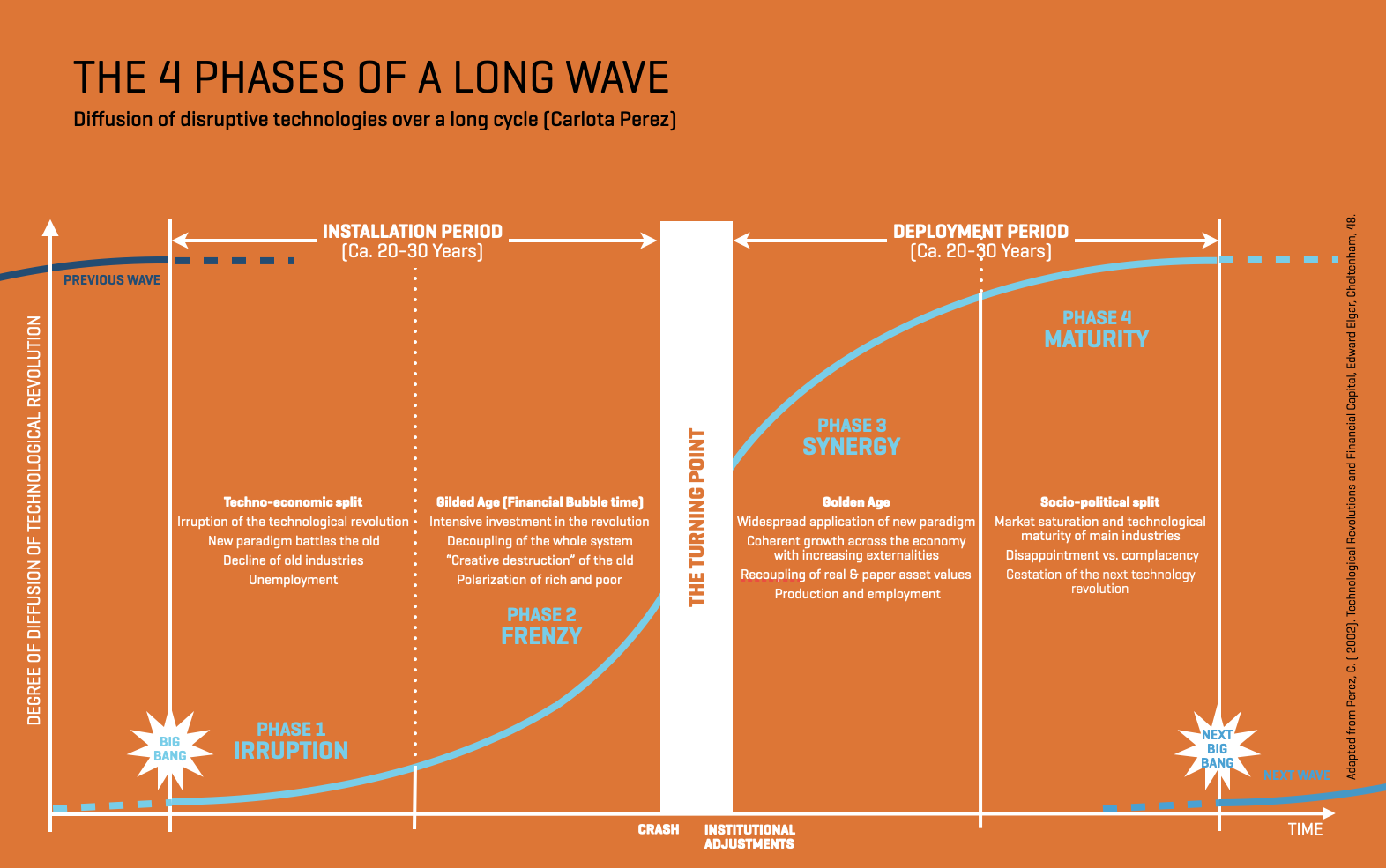
Read that carefully, because it contains the least intuitive fact in this whole article: the crisis in the middle of a wave is almost never a technology failure. It is a finance failure. The technology keeps working. The money stops.
One Hundred and Fifty Years on a Single Page
"History doesn't repeat itself, but it often rhymes," Mark Twain noted. Now overlay all three — the waves, the pendulum, the debt regime — and the rhyme becomes visible.
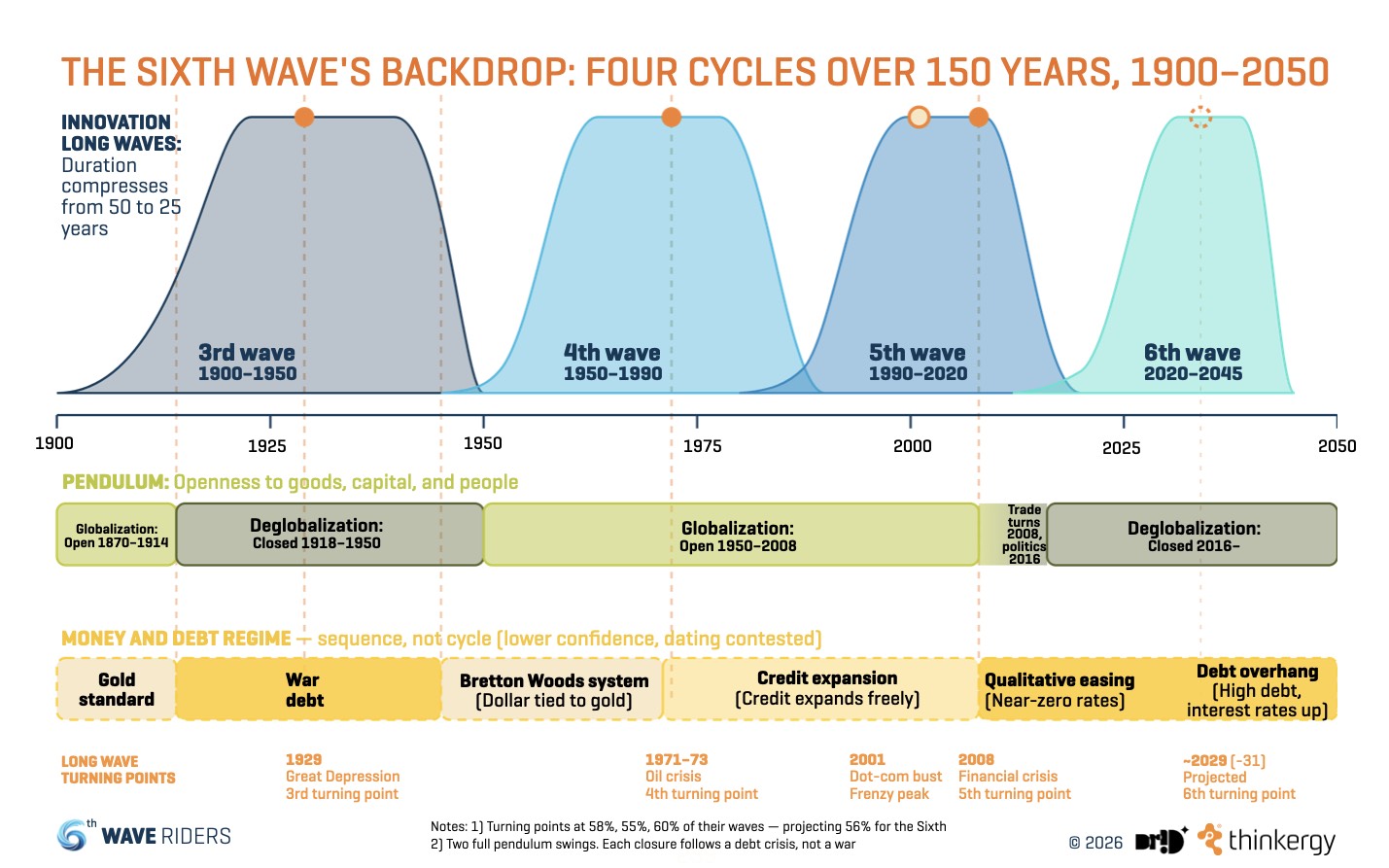
The Third Wave of electrification and mass production ran 1900 to 1950 — and had the worst luck imaginable. It unfolded inside a closed world, financed by war debt, and hit its turning point in 1929 with the Great Depression. The Fourth Wave, 1950 to 1990, was born into Bretton Woods stability and a reopening world, and reached its turning point with the oil crises of 1971 to 1973. The Fifth Wave, 1990 to 2020, drew the best hand in modern history: the peak of globalization, an expanding credit system, and — after the 2001 dot-com frenzy peak and the 2008 financial crisis that marked its turning point — a decade of near-zero interest rates that made capital almost free.
Every turning point sits past the middle of its wave. Every one of them was a debt crisis, not a war.
Why the Sixth Wave Is Not the Fifth
“The greatest danger in times of turbulence is not the turbulence,” Peter Drucker warned. “It is to act with yesterday's logic.”
Yesterday's logic was built for yesterday's weather. The Fifth Wave rewarded scale, network effects, and expansion — grow fast, grab the world, worry about efficiency later. Its underlying maxim was Faster. More. Always. The Sixth Wave arrives into geopolitical fragmentation, selective capital, high debt, and hard resource limits. Its maxim is Less, but Better. And that shift is not a matter of taste. It is an adaptation to the conditions.
The wave shows you where opportunity is moving. The tide decides whether you can reach it. So stop asking only what the technology makes possible. Start asking what the conditions will allow.
Which brings us to the uncomfortable question: when does this wave hit its turning point? My current hypothesis is around 2029. Why earlier than previous estimates? Technological waves appear to be accelerating, and the Fifth Wave’s true technology-investment turning point—the dot-com bust of 2000–2002—arrived much earlier in its cycle than the 2008 financial crisis. Add today’s extraordinary AI infrastructure boom, rapidly rising debt-financed investment, and growing warnings that the broader debt cycle may reach a reckoning toward the end of this decade, and 2029 emerges as a plausible strategic watch point. Not a prediction—but a date creative leaders should have on their radar.
I am not forecasting a date, and neither should you. “Those who have knowledge don't predict,” Lao Tzu knew. “Those who predict don't have knowledge.” A zone is not a prophecy. It is a posture. Now technology is arriving at the same conclusion at scale. Education, healthcare, products, and services are being tailored to individual needs rather than designed for a statistical mean that describes nobody. Fewer units, better fit, more value.

Five Moves for Creative Leaders
1. Install the long clock. Most leaders plan on a three-year horizon inside a fifteen-year weather system. Put the 150-year picture on your wall and check your strategy against it once a quarter.
Lesson: You cannot navigate a wave you cannot see.
2. Design for constraint, not abundance. Cheap capital and cheap resources are not coming back on the old terms. Build for value per unit of energy, material, capital, and attention. “The more constraints one imposes, the more one frees oneself,” Igor Stravinsky asserted.
Tip: Take your flagship offering and redesign it to deliver the same outcome with half the inputs.
3. Know which borders apply to you: atoms vs. bits. Deglobalization does not hit every business the same way — and the biggest mistake is defending against the wrong kind of border:
- If your business is made of atoms — components, factories, certifications, physical logistics — the Fifth Wave logic of one global supply chain serving one global market is finished. You now need designs that can be manufactured, certified, and deployed inside several blocs at once. Redundancy beats optimization, and it costs margin.
- If your business is made of bits, you are more mobile than you think — but do not mistake mobility for immunity. Your borders still exist. They run through export controls on advanced chips, data localization laws, sovereign AI mandates, payment rails a government can switch off, and visa regimes that decide whether your best people can join you where you are. And a patent is only as strong as the bloc willing to enforce it.
Questions: Which of your critical dependencies crosses a hardening border — and does that border stop goods, capital, people, or ideas?
4. Get your balance sheet ready before the turning point. Companies rarely die at a turning point because their technology was wrong. They die because their financing was. This is also where the hardest corporate timing decision lives: when to start redirecting resources from your mature Fifth Wave business toward Sixth Wave opportunity spaces, while the old business still pays the bills.
Questions: Could your company survive eighteen months of closed capital markets? And if not, what would you change this year?
5. Remember that the great fortunes are made after the crash, not before. Amazon and Google were both founded before the dot-com bust. They became giants in the deployment phase that followed it. The synergy phase after a turning point — when the frenzy has burned off and the real value creators are visible — is the richest entry point in the entire wave, for entrepreneurs and investors alike.
Lesson: The frenzy sorts the hype. The turning point sorts the survivors. The golden age belongs to whoever is still standing and still building.
Easier Said Than Done
Let me be honest with you. Knowing all of this does not make the decisions easy. Technologies are diffusing exponentially, the geopolitical map is being redrawn, and the financial backdrop is the least stable it has been in my working life. I may still get the timing wrong. You may still get the timing wrong. Awareness is not a guarantee — it is only the difference between being surprised and being prepared.
So whatever you decide this year, never forget:
Companies plan in years. Waves move in decades. The big picture takes a century.
Where are you making decisions today that quietly assume the last wave's weather?
© Dr. Detlef Reis 2026.
- The full framework behind this article is part of my forthcoming book, Riding the Sixth Wave of Innovation: An Innovation Strategy Playbook for Creative Leaders. Contact me if you want to know when it hits the shelves.
- And if you want to build this kind of foresight into your leadership team, get in touch with us about the Thinkergy Sixth Wave Thinking workshop.