


Open your laptop and ask an artificial intelligence a question. The answer arrives in two seconds. Five years ago, producing that same answer would have demanded a hall full of servers, a small power plant's worth of electricity, and a team of engineers to keep it all running. Today it fits in your backpack — and it is smarter than what filled the hall.
"Perfection is achieved not when there is nothing more to add, but when there is nothing left to take away," observed Antoine de Saint-Exupéry. He was writing about airplanes in the 1930s. Engineers are now proving him right in almost every technology space at once.
In April 2024, I proposed on this blog that the secret formula for riding the Sixth Wave of innovation (ca. 2020–2045) is best captured by one of the ten design principles of the German industrial designer Dieter Rams: "Less, but better." Back then, I saw it primarily as a new way of thinking — a mindset challenging the belief of earlier waves that more is always better. Today, let me share an observation that has emerged since: the technologies themselves appear to be following the very same logic.
A Pattern That Keeps Repeating
The more I study the technologies shaping the Sixth Wave across its three spaces — digital, clean, and human-centered — the more I notice the same design logic hiding beneath very different surfaces. Their objective is not simply to create more. Their objective is to create more value with fewer resources.
That sounds subtle. It is profound.
Throughout much of the earlier waves, progress was measured through expansion: larger factories, more products, more users, bigger platforms, more data, more energy, more consumption. Scale generated competitive advantage, and network effects rewarded whoever grew fastest. The Sixth Wave does not reject those achievements — it stands on them. But increasingly, advantage comes from raising the value created per unit of resource invested, whether that resource is time, energy, information, materials, attention, capital, or human effort.
So the guiding question is shifting:
Stop asking how you can create more.
Start asking how you can create greater value with less.
Richard Buckminster Fuller named this decades before it arrived. He called it ephemeralization — doing more and more with less and less. Fuller thought he was describing an engineering trend. He was describing an economy.
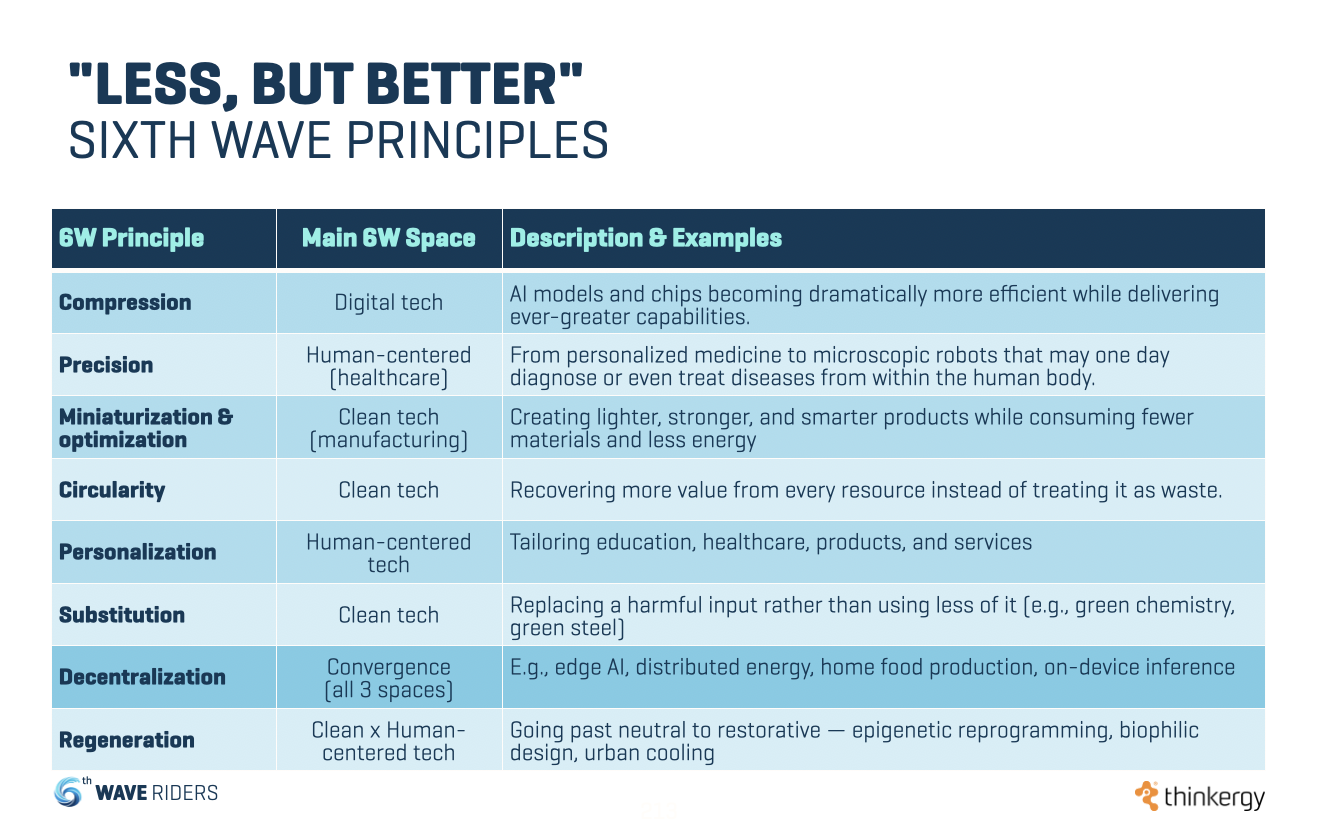
Here are five faces of the same principle.
1. Compression: The Digital Face
Artificial intelligence models and the chips beneath them are becoming dramatically more efficient while delivering ever-greater capabilities. A model that required a data center two years ago now runs on a handheld device. The frontier is no longer only raw size — it is intelligence per watt, capability per parameter, insight per second of compute.
Tip: Audit one workflow in your business this month and ask not "how do we do more of this?" but "how do we get the same outcome with half the input?"
2. Miniaturization: The Manufacturing Face
Products are becoming lighter, stronger, and smarter while consuming fewer materials and less energy. Generative design software now produces components that look like bone or coral — organic, hollowed, strange to the eye — because the algorithm places material only where force actually travels. Additive manufacturing then builds the part by adding material rather than by carving 90 percent of a metal block into scrap.
Lesson: In the Sixth Wave, the elegant solution and the economical solution are converging into the same solution.
3. Circularity: The Clean Face
"Earth provides enough to satisfy every man's needs, but not every man's greed," Mahatma Gandhi asserted. The clean technology space is slowly learning to design as if that were a hard engineering constraint rather than a moral appeal — recovering value from every resource instead of writing it off as waste. Battery materials, rare earths, water, heat: each is being redefined from output to input.
Questions: What does your company currently pay to throw away? And what would it be worth if you designed it back into the system?
4. Personalization: The Human Face
For more than two decades, I have taught creativity to university students and corporate teams. In every class I have ever run, a hard truth applies: teach to the average of the room and you teach to no one in it. The Ideators are bored, the Systematizers are anxious, and the Imaginative Experimenters have already stopped listening. That is why we built TIPS — Thinkergy's talent & innovator profiling system — around individual creative styles rather than around the mythical average learner.
Now technology is arriving at the same conclusion at scale. Education, healthcare, products, and services are being tailored to individual needs rather than designed for a statistical mean that describes nobody. Fewer units, better fit, more value.
Tip: Stop designing for everyone. Start designing for someone.
5. Precision: The Medical Face
In May 2019, I woke at five in the morning with a numb, burning discomfort in my chest and armpits, drove myself to an emergency room, and learned I was having a heart attack. Ninety minutes later, a surgeon had removed the clot and threaded a stent — a few millimeters of metal mesh — into the artery that had closed. That small object is the reason I am writing this sentence.
It is also, I now realize, Fifth Wave engineering. A physical object. Delivered by catheter. Left in place for the rest of my life.
Consider what came next. In late 2025, a research team in Zurich published a magnetically guided microrobot they describe as clinically ready — a capsule steered through the arteries by an external magnetic field at four millimeters per second, tested in living animals under realistic clinical conditions, able to reach a clot, dissolve on command, and release its drug payload exactly where it is needed. Today, clot-busting drugs flood the entire body, which is why doses must be high and internal bleeding is a real risk. Tomorrow, the dose goes to one location, and the machine that carried it simply disappears.
Less material. Less collateral damage. More life. Fuller's ephemeralization, arriving inside a human artery.
When the Waves Converge
These are only early signals. As the three Sixth Wave technology spaces converge, they will begin to reinforce one another. Artificial intelligence will accelerate scientific discovery. Materials science will enable cleaner technologies. Precision medicine will lean ever harder on AI. Quantum technologies may unlock levels of optimization that are difficult to imagine today.
The specific technologies will keep evolving. The underlying design principle already looks remarkably consistent — which is why one section of my forthcoming book on the Sixth Wave is devoted entirely to it.
Perhaps that is why "Less, but better" feels so powerful. It is not merely a philosophical aspiration or a sustainability slogan. It increasingly describes the direction of technological progress itself.
In a coming article, let me take you one layer deeper beneath this pattern — to what I believe is really driving it.
For now, hold on to this. "To attain knowledge, add things every day. To attain wisdom, subtract things every day," Lao Tzu advised. The Sixth Wave is where that ancient counsel stops being spiritual advice and starts being a business strategy. The true measure of innovation will no longer be how quickly you scale, how many users you acquire, or how much output you maximize — but how much meaningful value you create from every unit of time, energy, information, material, capital, and human effort you invest. The future belongs not to those who create the most, but to those who waste the least.
© Dr. Detlef Reis 2026.
- Where do you already see "Less, but better" showing up in your own industry — and where is your organization still competing on volume in a market that has quietly started rewarding value?
- Are you a creative leader wondering how to prepare your team and company for the Sixth Wave? Contact us to tell us about your industry niche and current challenges, and we will tailor a solution bundle to make you "Sixth Wave ready."