


Where do breakthrough ideas come from? From looking closely at your challenge? Or from looking far away from it?
Recently, I was selecting the Ideation tools for the innovation case in my Creativity and Ideation Techniques course in the MBA-i program at Bangkok University. As I went through the X-IDEA Toolbox, I was reminded of several Thinkergy innovation projects from recent years — and suddenly saw a connection I had never written about. How far a creativity tool takes your thinking away from your challenge shapes how big your ideas can become.
Today, let’s look at creativity tools through this lens of distance — and at what it means for anyone who designs an Ideation session.
Why Creativity Tools?
When we ask teams in a Thinkergy workshop to simply brainstorm on a challenge, the same pattern always emerges: many of the same ideas show up in every group. Common ideas, not original ones. The ideators are stuck in the tunnel of expertise and conventional thoughts.
As I explained in an earlier article on the inner workings of creativity tools, creativity tools are mechanistic processes that reliably push your thinking to a new starting point outside that tunnel. A trigger — an association, a mental image, a fresh perspective, or a formal scheme — does the pushing. From the new starting point, fresh ideas come more easily.
But here is a question I had never asked before: How far away is that new starting point?
Near or Far? Two Kinds of Stimuli
“Creativity is just connecting things,” said Steve Jobs. The question is which things — those close by, or those far away?
- Related stimuli stay close to home. They keep you near your Final Challenge — and near your company’s industry, category, or domain. Attribute Listing has you break your offering down into its features. Lotus Blossom Matrix places the challenge in the center and has you branch out into related elements such as places, needs, or customer groups, which then trigger ideas close to home. Morphological Matrix builds a table of challenge-related elements and combines them into new ideas.
- Unrelated stimuli do the opposite. They take you far away from your challenge and your familiar environment — so that the ideas you bring back are further removed from conventional thinking, too. Random Word, Other Worlds, Animal Kingdom, and Star Advisor Board all work this way. In two earlier articles on randomness (Part 1 | Part 2), I described a coffee-shop case where the random word “shop” was useless. It was too close to the challenge. The next noun, “museum,” instantly sparked fresh ideas.
What counts is not how far a tool’s words are from your challenge, but how far its starting point is from your usual thinking. Take Reversal. It keeps the challenge’s words but turns its goal upside down: you create ideas for the opposite of what you want to achieve. That is about as far from conventional thinking as you can get — so Reversal belongs with the unrelated tools. Assumptions Reversal, by contrast, flips your assumptions while you still pursue your original goal. It stays close.
Mapping the X-IDEA Toolbox
Here is how the Ideation tools in our X-IDEA Toolbox sort by stimulus type:
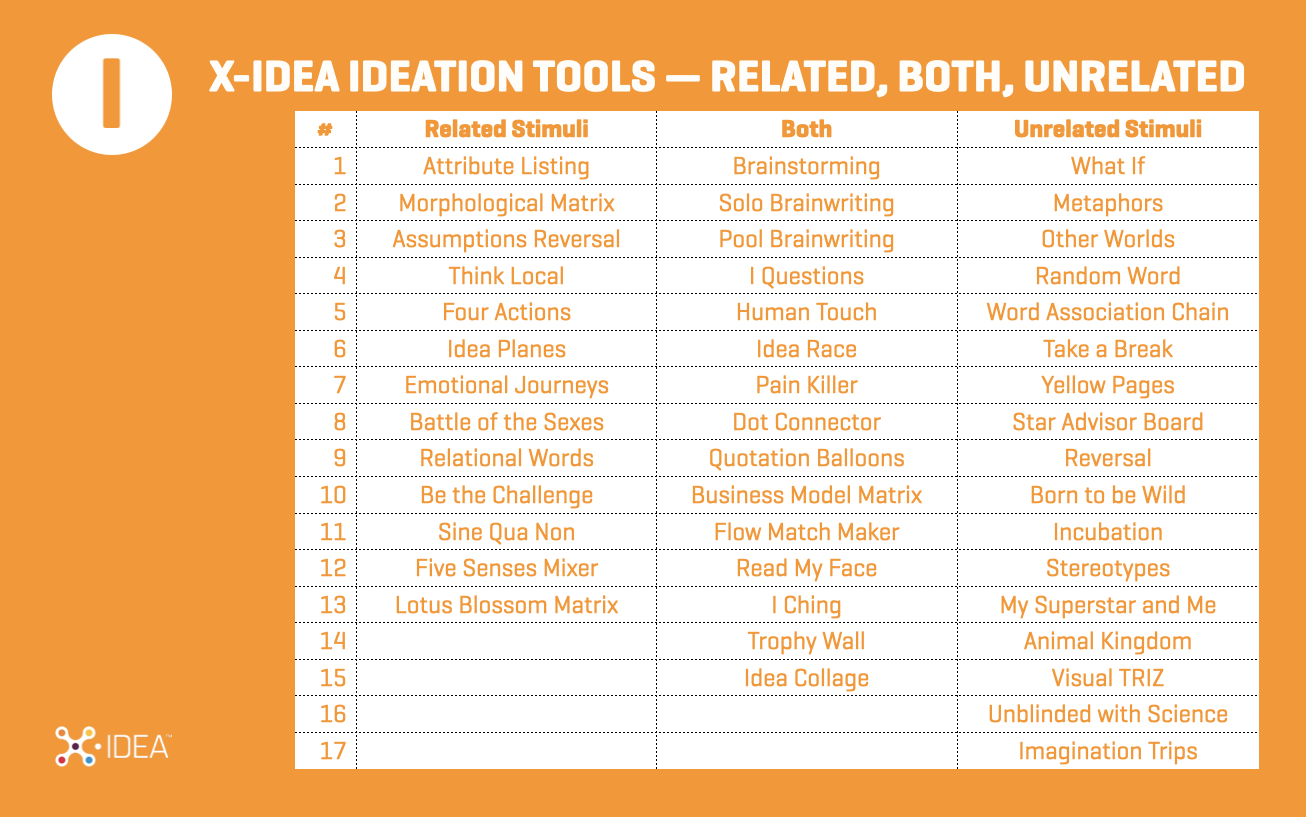
The middle column needs a word of explanation. Tools in the “Both” category can work either way — it depends on how the facilitator uses them and which stimuli the team feeds in. The same is true for Brainstorming, Solo Brainwriting, and Pool Brainwriting, which are really communication styles rather than stimulus techniques: you can run almost any tool in any of these styles.
How Stimulus Distance Shapes Innovation Impact
Now to the connection that made me want to write this article. At Thinkergy, we distinguish five levels of innovation impact:
- Incremental improvement
- Incremental to evolutionary
- Evolutionary
- Evolutionary to revolutionary
- Revolutionary innovation
And here is the link:
The more related tools you use in an Ideation session, the more likely it is that most of your ideas will be incremental — close to the market, familiar, and easy to implement. The more unrelated tools you use, the more likely it is that some of your ideas will be revolutionary — unconventional, surprising, and interesting.
Notice the difference between most and some. Unrelated stimuli don’t guarantee a breakthrough. They raise the odds. Many ideas from a far-removed starting point won’t survive — but the few that do can change the game. As Linus Pauling noted: “The best way to have a good idea is to have lots of ideas.”
Four Steps to Design Your Ideation Session
What does this mean if you design and facilitate Ideation sessions? Stop asking only, “Which tools should we use?” Start asking, “How far should these tools take us?”
1. Know your Final Challenge. Everything starts with a clear, well-framed Final Challenge, phrased as a “How to…” action question. Only when you know exactly where home is can you decide how far to travel from it. Tip: Write the Final Challenge where every ideator can see it throughout the session.
2. Agree on the impact you want. Together with your client, clarify where on the five levels you aim. Incremental improvement? Revolutionary innovation? Or somewhere in between? Question: How much change does your organization truly want — and how much can it digest?
3. Make enough time. The target impact decides how many tools you need — and the number of tools decides how much Ideation time you must make available. As a rule of thumb, an incremental session works with around six tools, while a revolutionary session calls for up to twelve. As I noted in an earlier article on innovation impact: what you put in is what you get. Lesson: Revolutionary ideas don’t come out of a rushed afternoon.
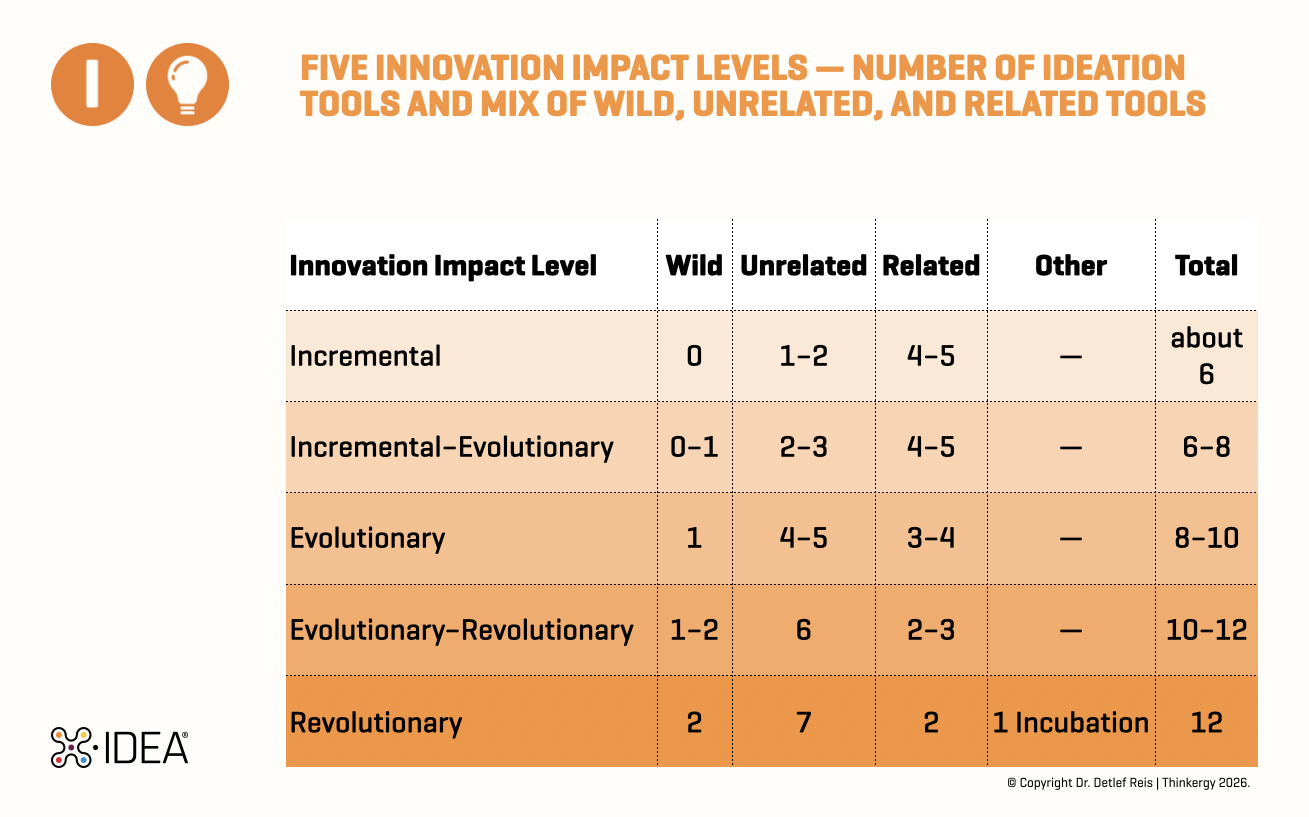
4. Tune your mix — and add a dose of wild. As your target impact rises, shift the balance from related to unrelated tools. An incremental session leans mostly on related tools, with just one or two unrelated ones. A revolutionary session flips this: only two related tools, the rest unrelated. When you aim for evolutionary to revolutionary ideas, also add wild-idea tools such as What If, Reversal, and Born to Be Wild. As Albert Einstein observed: “If at first the idea is not absurd, then there is no hope for it.” And at the revolutionary end, build in Incubation — let the team step away, and let life deliver the most unrelated stimuli of all. Tip: Place your wild-idea tools toward the end of an Ideation stretch, when the team is tired enough to stop listening to their inner voice of judgment.
Close or Far?
Every Ideation session is a journey that can take you anywhere from the mundane to the insane. Stay close to your challenge to improve; travel far away from it to revolutionize.
So, think back to your last Ideation session. How far did your stimuli take you — and was that the impact you wanted?
© Dr. Detlef Reis 2026.
- Planning an innovation project and aiming beyond incremental ideas? Let Thinkergy design and facilitate an Ideation session that takes your team as far as your challenge demands. Get in touch.
- Want to master the full X-IDEA Toolbox — related, unrelated, and wild? Discover X-IDEA, Thinkergy’s innovation method, and our training and licensing programs for innovation facilitators at thinkergy.com/methods/x-idea.
- Which tools you naturally enjoy also depends on your talent type — see who likes playing with what kind of thinking tools, or discover your own type at tips-profile.com.