

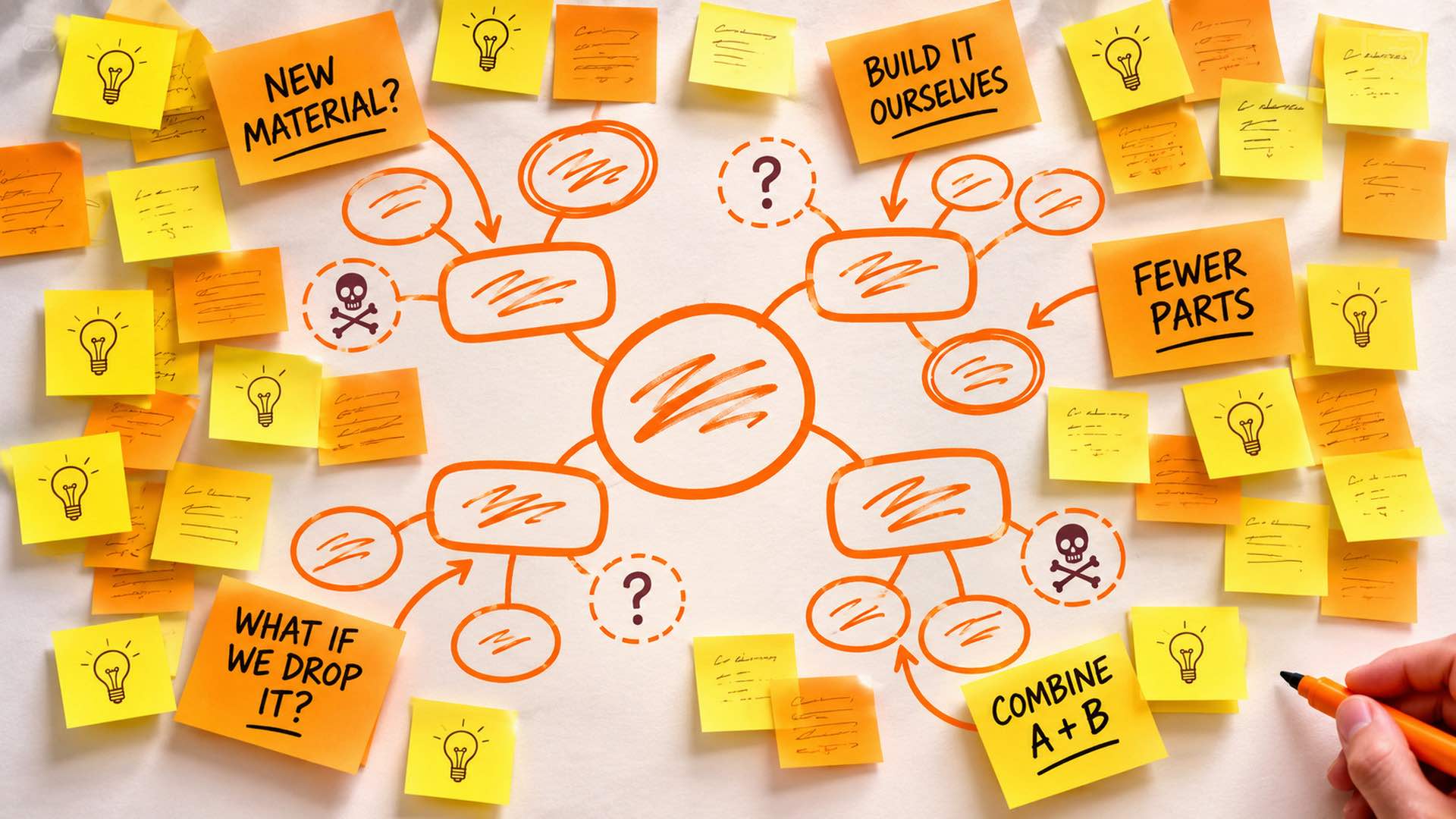
Picture a giant sheet of brown paper on a wall. In the center sits a system. Around it, a few truths are circled in thick marker. Others are flagged with a skull and crossbones. And ten people stand in front of it, markers in hand, ready to rebuild it from scratch.
Welcome back to our two-part series on first principles thinking. In Part 1, we used First Principles First to boil a challenge down to its essential truths and expose the conventions that only look like truths. Today, let’s turn that bedrock into breakthrough ideas with the First Principles Springboard, a new tool in the Ideation stage of X-IDEA.
Truths Are Not Yet Ideas
Essential truths are only half the work. They tell you what any solution must respect, but they don’t tell you what to build. The ideas come when you use the truths as a springboard — and when you combine them in ways nobody has tried before.
As Francis A. Cartier noted: “There is only one way in which a person acquires a new idea: by the combination or association of two or more ideas he already has into a new juxtaposition in such a manner as to discover a relationship among them of which he was not previously aware.”
That’s why recombination is the heart of the tool.
How the First Principles Springboard Works
- Review your Final Challenge and walk the team briefly through the outputs of First Principles First. Don’t debate the truths again; they were settled in Xploration.
- Create the springboard map. Place the system in the center and the categories from your breakdown as the first branches. On the next layer, circle the essential truths, flag the conventions to drop with a pirate symbol (☠), and mark open components with “?”.
- Conduct a fast and furious stimulus burst. For about ten minutes, everyone adds alternatives to the springboards from their own know-how: other materials, technologies, resources, formats, people, places. Pirate branches ask, “What if we drop this entirely?” Open components become “What if …” branches.
- Write raw ideas alone. In silence, each member writes 8 to 10 raw ideas on Post-its, using the giant map. At least half must combine springboards from two different branches. Tag each idea with the springboards it came from.
- Harvest. Read the ideas out and stick them on the map next to the springboards that sparked them.
The two moves are deliberate. First, the team thinks together and fast — this brings in its diversity. Then everyone thinks alone — this protects the ideas from groupthink and from the loudest voice in the room.
Rebuilding the Battery: A Thought Experiment
Let’s return to Elon Musk’s battery from Part 1. We don’t know how Tesla’s teams actually generated their ideas. But imagine they had used a springboard map. They would have circled the truth that the materials cost only about 80 dollars per kilowatt-hour. They would have flagged two conventions with the pirate symbol: “buy finished cells from suppliers” and “pack thousands of small cells into modules.” And they would have put a “?” on an open question: Do cathodes need cobalt?
Add a few stimuli — Henry Ford’s River Rouge plant, where iron ore went in and cars came out; the fuel tank built into an aircraft wing; a scrapyard — and the raw ideas almost write themselves:
- Build our own giant cell factory (truth + ☠ suppliers + River Rouge).
- Make bigger cells with fewer parts, and build the pack into the car floor as part of the body (☠ small cells + ☠ modules + aircraft wing).
- Use cobalt-free iron-phosphate cells for the standard model (truth + ?).
- Take old batteries back and recover their metals (truth + scrapyard).
None of these ideas improves the existing battery pack. Each rebuilds a part of it from the truths. And versions of all four later became reality.
DOs and DON’Ts
- DO insist on concrete names. “New materials” is not a stimulus; “graphene” or “mycelium” is. “Better marketing” is not a stimulus; “a K-pop fan club” is.
- DO give the pirate branches special attention. “What if we drop this entirely?” is often the richest question on the map. As Pablo Picasso put it: “Every act of creation is first an act of destruction.”
- DON’T reopen the truths. If someone disputes one, park it and carry on.
- DON’T accept “improvement” ideas as the bulk of your output. A slightly better version of what exists is reasoning by analogy again.
- DON’T kill an idea that breaks a truth. Mark it with a small “!” and keep it. The Development stage may find a way to make it work.
Springboarding a New Kind of Innovation Project
In Part 1, I shared how we used First Principles First to rethink the innovation project itself for the Sixth Wave. We then ran the First Principles Springboard on the results with an ideation team of ten. Our map held seven essential truths, eight conventions to drop, and two open questions.
Two things stood out. First, the most fertile springboard wasn’t a convention to drop but a truth: senior people’s time and attention are the scarcest resources in any project. Second, the best ideas came from crossing branches — and the stimuli came from everywhere: outsourcing models, spell-checkers, sports match replays, documentary films.
Here are a few of the raw ideas:
- Hand the whole project to the innovation facilitator. Let them run it end to end, so the client’s executives invest only three to four hours across the entire project, at a few short decision points — instead of 20 to 30 people away from their jobs for two to five days.
- Give every stage a digital coach. Like a spell-checker for the method, it alerts the team the moment it skips the insight step or mixes development into ideation.
- Replace the final report with a “match replay.” The client can scrub through the whole project, and every move opens its source and reasoning.
- Let every claim speak in the customer’s own voice. Each insight carries a short clip of a real customer saying it, like archive footage in a documentary.
These are raw ideas, not finished concepts. But not one of them makes the old workshop a little better. Each one rebuilds the project from what is true.
Which Convention Will Walk the Plank?
As Grace Hopper warned: “The most dangerous phrase in the language is ‘We’ve always done it this way.’” First Principles First helps you spot that phrase hiding in your challenge. The First Principles Springboard helps you leap beyond it. Keep the truths, drop the habits, and recombine what remains.
So, look at your own industry. Which convention is ready to walk the plank — and what will you build in its place?
Facing a challenge stuck in “how it has always been done”? Let Thinkergy guide your team from first principles to breakthrough ideas in an X-IDEA innovation project. Get in touch.
Want your team to master first principles thinking and 150 more X-IDEA thinking tools? Explore our X-IDEA training and licensing programs at thinkergy.com/methods/x-idea.
© Dr. Detlef Reis 2026.